 Aerial Photographs of Rossmoor
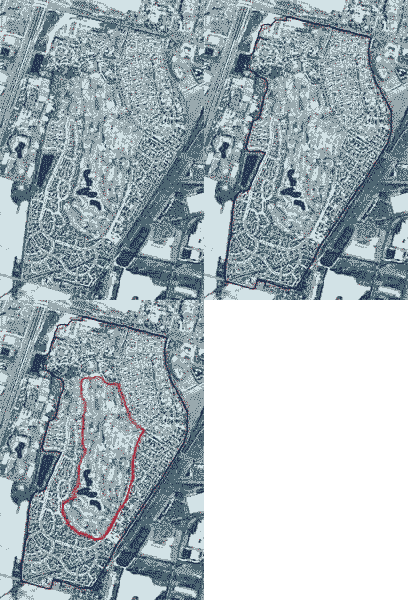
To the left is a high altitude aerial map of Rossmoor taken in 1995 and reproduced here courtesy of the USGS (US Geologic Survey).
The Rossmoor Community of 2303 units and 3000 residents is outlined in dark blue. The New Jersey Turnpike is the North/South road to the left. The 104 acre golf course is outlined in red. A writer about the designer Desmond Muirhead once observed, “His concept was that the golf course determined the shape of the community and not the other way around.”
Approximately 40 community units create the western and southern boundaries of the course, while the course to the north and the east is open to be seen by the community as they drive or walk about the perimeter. The road within Rossmoor circles the course completely.
One of the special beauties of Rossmoor is the large green expanse of the course, its manicured grass, lovely trees of many different varieties, and people actively enjoying use of the golf course.
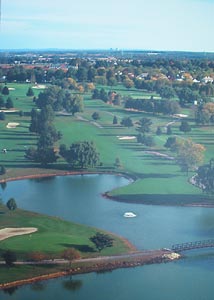 This is a lower altitude aerial photograph of the course looking north at a time when autumn was overtaking Rossmoor.
The small fountain in the lake as well as the arched wooden bridge near the 2nd hole can be seen at the lower right of the picture.
A Diagram of Muirhead’s Course
The course is built on the “2 loops of nine” design. (Follow the holes starting at the top right of the diagram.)
This idea was first presented in print by Alister Mackenzie in his famous book, Golf Architecture which points out the advantage of this configuration. It creates 2 starting points within the course from which to start play, and a halfway point for players to stop should they so desire.

On entering the Golf Course . . .
the Driving Range is first on the left, and the Putting Green is just beyond.

A closer look at several holes
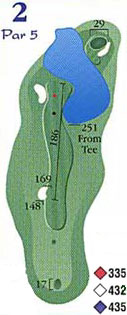
The 2nd Hole
This hole is considered by our Pros as one of the most interesting on the course. Despite being relatively short, it is still a Par 5. The best chance of getting home in 2 is by going down the left side of the Fairway — a drive of about 250 yds. The second shot is about 175 yds and goes over water. As the pond is quite wide and to the left of the green, it can be very intimidating.
The hole itself — in the midst of the course — is well guarded by numerous trees, two of which are on the corner and are the reason for the recommendation to stay left.
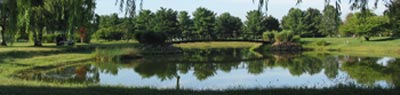
Looking across the lake toward the 2nd hole, and the small bridge which goes between the fairway, the water and the green.
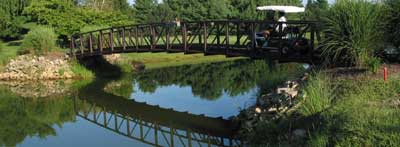
Driving a cart over the bridge to the green on the 2nd hole.

Preparing to play the green on the 2nd hole.
The 5th Hole

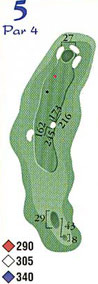
Positioned along the southern extent of the course, this hole lies between two rows of trees with 2 bunkers along the sides, and three others surrounding the green.

Teeing off from the 5th hole puts the golfer along the edge of the course beside the manors which — along with the trees — define the border.

The elevated green of the 5th hole — looking back from which allows a beautiful panoramic view of the course.
The 10th Hole
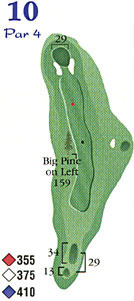
This hole is one of the favorites of our Pro. A Par 4, it has a dogleg to the left well guarded by trees to both the left and the right. The hole plays longer than the dogleg shown on the card.
Playing the hole requires hitting uphill to an elevated green which is well bunkered on both the left and the right. The green has considerable slope from back to front, and the challenge of putting the hole depends greatly upon pin placement.

The 12th Hole
Best on the course, this Par 3 hole requires a very accurate T-shot because of water fronting the green and all along its left side. Note the bunkers to the right of the green. If a golfer comes up short, it could result in a very wet golf ball! The challenge of this hole is the difficulty in getting to the green, as there is no “safe” area to miss the shot.


The 18th Hole
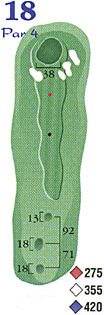
The green itself is a “3 club” green — for depending upon pin placement, club selection is vital. It has the largest area of any green on the course. The “key” to success is always a good, solid and lengthy T-shot at the start.
(It is interesting to note that the Rossmoor Course Greens are generally larger than those on most other golf courses.)